

Lets Compare CC Loan vs. OD Loan vs. Business Loan: Which is Best for Your Business in Dec 2025?
Table of Contents
As a business owner in India, you know that growth needs fuel. That fuel is often capital. But when your cash flow hits a snag or an opportunity knocks, which financial tool do you reach for? Is it a Cash Credit (CC) limit, an Overdraft (OD) facility, or a traditional Term Business Loan?
Choosing wrong can mean paying unnecessary interest or struggling with inflexible repayments. This guide cuts through the confusion. We’ll explain each option in simple terms, compare them directly, and give you a clear framework to choose the best financing for your business needs in 2025.
Let’s Compare Head-to-Head:
Before we dive deep, here’s a clear snapshot of how these three popular business credit options stack up against each other.
| Feature | Cash Credit (CC) | Overdraft (OD) | Term Business Loan |
|---|---|---|---|
| Primary Purpose | Working capital for daily operations (inventory, salaries) | Flexible credit line for cash flow gaps or emergencies | Specific, one-time investment (machinery, expansion, startup capital) |
| How You Get Money | Revolving limit in a separate CC account; draw and repay as needed. | Linked to your current or savings account; use funds up to a limit. | Lump sum disbursed to your account at once. |
| Interest Charged On | Only the amount utilised, not the full limit. | Only the amount utilised, calculated daily. | Full sanctioned amount, from day one. |
| Repayment Style | Highly flexible; repay and redraw within the limit. | Very flexible; repay anytime, no fixed EMIs. | Fixed monthly EMIs over a set tenure (1-7+ years). |
| Tenure | Usually 1 year, renewed annually. | Usually 12 months, renewable. | Longer term, from 1 year up to 10 years or more. |
| Collateral Required | Almost always secured by inventory, receivables, etc. | Can be secured (against FD, property) or unsecured (against salary/turnover). | Can be secured or unsecured; unsecured is common for smaller loans. |
| Best For | Manufacturing/trading businesses with regular working capital cycles. | Managing uneven cash flow, emergency expenses, short-term needs. | Planned, large expenses like buying assets, business expansion, or starting up. |
Now Let’s Understanding Cash Credit (CC)
What is a Cash Credit Loan?
A Cash Credit (CC) account is a revolving, secured credit facility designed primarily to meet the day-to-day working capital needs of a business. Think of it as a dedicated credit account for your operational expenses. The bank sanctions a limit based on your stock and debtors, and you can draw funds as needed to pay suppliers, manage inventory, or cover salaries.
How Does It Work & Who is it For?
-
Mechanics: You pledge current business assets like inventory, raw materials, or receivables as collateral. Interest (typically between 10% to 18% p.a.) is charged only on the daily outstanding balance.
-
Ideal User: This facility is a staple for manufacturers, traders, and distributors whose business involves a constant cycle of buying stock, selling it, and waiting for payments. It’s perfect when your funding needs are recurring but the exact amount varies daily.
Demystifying the Overdraft (OD) Facility
What is an Overdraft Loan?
An Overdraft (OD) is a flexible credit line attached to your existing current or savings account. It allows you to withdraw money beyond your account balance, up to a pre-approved limit, effectively preventing cheque bounce and managing shortfalls.
Types, Rates, and Best Uses
ODs come in various forms, impacting their interest rates and eligibility:
-
Secured OD: Backed by collateral like a Fixed Deposit (FD) or property. Offers lower interest rates (e.g., SBI charges ~1% above the FD rate).
-
Unsecured OD: Granted based on your income or business turnover. Has higher rates, generally between 10% – 17% for personal OD and 9.5% – 14.5% for business OD.
-
When to Use It: Choose an OD for unpredictable expenses, to cover a temporary cash flow gap while waiting for a payment, or for a short-term business opportunity. It’s your financial safety net.
Easy to Understand Business Loan
What is a Business Loan?
A business loan provides a fixed lump sum of capital for a specific, one-time business purpose. It’s repaid in equated monthly instalments (EMIs) over a fixed tenure.
Purpose, Terms, and Application
-
Common Uses: Launching a startup, purchasing commercial property, buying expensive machinery, or funding a major expansion project.
-
Key Terms: Interest rates vary widely. Secured loans start as low as 10% p.a., while unsecured loans can range from 12% to 25% p.a.. Tenures can extend up to 10-15 years for large loans.
-
The Process: Approval hinges on a strong business plan, financial statements, and credit history. For MSMEs, government-backed schemes like CGTMSE can facilitate collateral-free loans. The digital process is now swift, with some lenders promising approvals in principle within minutes.
The Decision Guide: Which One Should You Choose?
Use this simple flowchart to match your need with the right product:
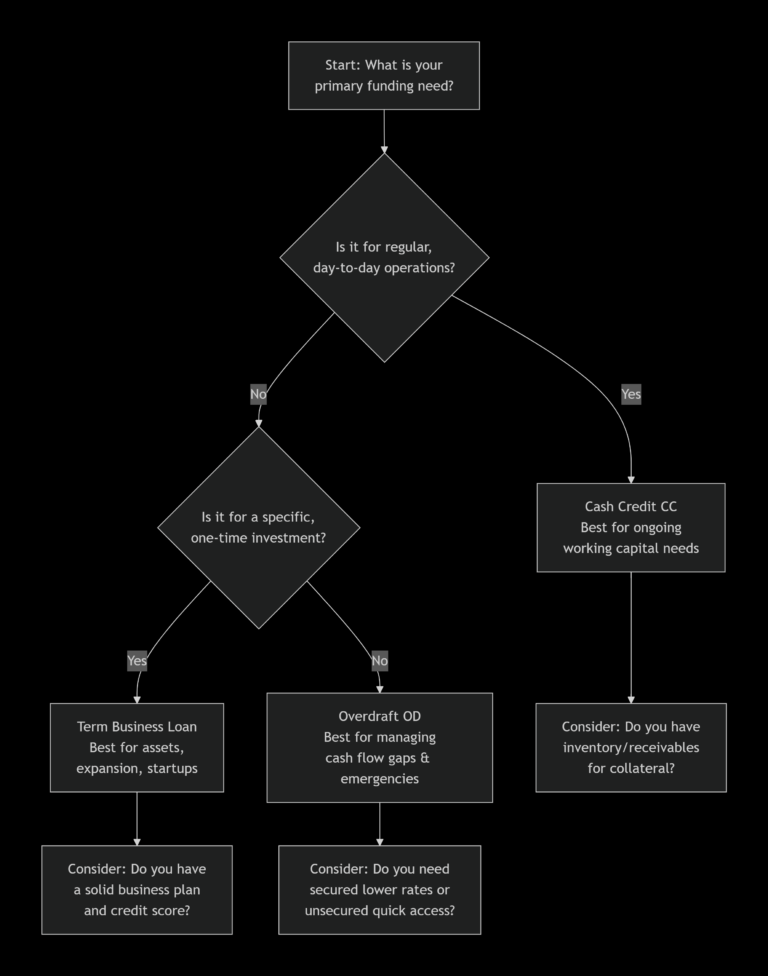
Ask yourself these key questions:
-
Is my need short-term and fluctuating? → OD or CC.
-
Do I need a large sum for a long-term goal? → Term Loan.
-
Do I have assets to pledge for lower rates? → Secured OD or CC.
-
Do I value flexible repayment over predictability? → OD or CC over a Term Loan.
How to Strengthen Your Application
Regardless of your choice, a strong application shares common traits:
-
Maintain a high credit score (CIBIL of 750+ is ideal).
-
Keep financial documents (GST returns, ITRs, bank statements) organized and updated.
-
For ODs/CC, a healthy transaction history in your business bank account is beneficial.
FAQ: Your Questions Answered
1. Is an OD better than a business loan?
It’s not about better, but about fit. An OD is cheaper for short-term, variable needs because you pay interest only on what you use. A business loan is better for large, planned investments where you need the full amount upfront.
2. What is the difference between CC and OD?
Both are revolving credits, but CC is designed specifically for cyclical working capital against inventory. OD is a more general-purpose buffer linked to your bank account and can be used for both business and personal emergencies.
3. Can I get an OD without collateral?
Yes. Many banks offer unsecured OD facilities to salaried individuals against their salary or to businesses based on their turnover and banking relationship.
4. What are the interest rates in 2025?
Rates vary by product and lender:
-
Business OD: ~9.50% – 14.50% p.a.
-
Business Term Loans: ~8% p.a. onwards for public sector banks, higher for NBFCs.
-
Cash Credit: Typically similar to or slightly above secured business loan rates.
Navigating business finance is about choosing the right tool for the job. A Cash Credit keeps your daily operations smooth, an Overdraft acts as a flexible safety net, and a Term Business Loan fuels your major growth leaps.
Still unsure which path is right for your business’s unique situation? At Densi Associates, we help Indian business owners like you cut through the complexity. Let’s have a quick, no-obligation conversation to review your plans and identify the most efficient and cost-effective way to fund your next growth chapter.

Leave a Reply